Another project lands late. You sit through the debrief, trying to figure out what went wrong, and make a mental note: Next time will be different.
But then… it isn't.
If you run a creative team, this probably sounds familiar. Not because your team isn't good (they are). Not because nobody cares (everyone does).
But somewhere between the brief landing and the work going out the door, something keeps going sideways. And the honest answer to where, exactly, is hard to pin down.
The post-mortem always finds something. The client was slow to approve. The PM didn't catch the risk early enough. The designer underestimated how many rounds it would take. These things are true, and they're worth addressing. But they tend to be the last thing that went wrong, not the first.
The earlier problems were quieter: a brief that meant something slightly different to everyone who read it, feedback arriving across four different channels, an approval given over a Zoom meeting that nobody recorded. Small things, on their own. Compounding things, together.
The truth is, most deadline problems are structural. They're not about effort or intention.
They're about the system the work moves through, and whether that system was actually designed for how creative work happens.
Usually, it wasn't. So where does it actually go wrong?
1. The brief (it's further back than you think)
A brief that lives in an email attachment or a set of kickoff notes is a brief that means something slightly different to everyone who reads it.
That gap tends to stay invisible until the first draft lands. And because the brief is where scope, deliverables, and expectations are set, any ambiguity baked in at the start gets more expensive with every passing week.
A few specific ways this plays out:
Scope expands without being formalised.
The client mentions, "oh, could we also do a version for Stories?" on a call. The account manager nods. No one updates the brief, no one revises the timeline, and three weeks later the creative team is delivering two formats when they budgeted for one.
Scope creep of this kind rarely feels like a decision at the time. It just feels like a small accommodation.
But that's how it gets you: one small accommodation doesn't look like much, then another one comes along, and eventually the original scope isn't really the scope anymore.
The fix isn't to say no more often. It's to have a brief that's live, shared, and versioned, where any change requires an explicit acknowledgment rather than a nod on a call, and everyone can see exactly what was agreed and when.
Deliverables are defined loosely, so "done" is always negotiable.
When a brief says "social assets" rather than "6 square static images at 1080x1080 for Instagram feed," the client retains the ability to define completion on their own terms.
This isn't usually bad faith. The client genuinely didn't think through the specifics at the brief stage, and neither did anyone push them to. So when the work lands and it isn't quite what they imagined, another round begins. Revision cycles that feel infinite are often a sign that the brief never drew a clear enough line around what was being made.
The simplest remedy is also the most obvious one: granular deliverable specs at the start - format, dimensions, duration, quantity - give both sides something concrete to come back to when the definition of done comes into question. It's a five-minute conversation during briefing that can save hours later.
The brief isn't connected to the work it describes.
Even when the brief is clear and agreed upon, it often lives somewhere separate from the project itself.
Tasks get created, files get produced, but the brief is two tabs away in a Google Drive folder that half the team can't find.
So when a scope question comes up halfway through the project, there's no obvious place to go for the answer. The question gets asked in Slack, someone gives their best recollection of what was agreed, and work continues from there.
The easiest way to fix this? Make the brief inseparable from the project: pinned, always accessible, the first thing anyone sees when they open the work.
2. Nobody is quite sure which file is the right one
Creative work produces assets. Lots of them. Drafts, versions, alternates, references, finals that turn out not to be final.
At any given moment, the same file can be finished in the creator's eyes, unreviewed internally, awaiting client approval, or sitting in a folder nobody has opened for days.
Keeping track of which state a file is in, and making sure the right people know, is work that most teams are doing manually, informally, and imperfectly.
There is no record of what was approved, by whom, or when.
The creative director, the brand manager, and the head of marketing all get on a call to discuss a brand campaign. Everyone seems aligned, the team gets a clear verbal go-ahead, so you brief the photographer, lock the shoot date, and move into production.
Then, a week before delivery, the head of marketing comes back saying the visual direction feels off-brand and they'd like to revisit the colour palette.
When you point out that the direction was approved on the call three weeks ago, the creative director says they thought that was a directional conversation, not final approval. The brand manager doesn't remember the specifics.
Nobody is lying, exactly. But without a structured approval record, the agency has no real ground to stand on. The conversation becomes a matter of competing recollections, and the client will usually have the stronger position.
Ultimately, things slide back into another revision round, and the time and cost of it sits entirely on your side.
Make approval a discrete, recorded event tied to a specific file version, and that conversation takes thirty seconds instead of half a day. It also ends differently.
New versions get shared without retiring old ones.
The designer sends V3 over email - "updated version attached." The client, who still has V1 open in a browser tab from a week ago, doesn't register the new attachment. They leave their feedback based on what's in front of them, which is a version that's already been addressed.
The designer reads the notes, confused, because half of this was fixed in V2. A round of back and forth follows before anyone figures out what happened. Another day passes.
This particular cycle is almost comically avoidable, and yet it happens constantly. Getting clients onto a proper review tool is its own battle: another login, another platform to navigate, another thing to figure out before they can just look at the file. For a client who reviews work once a fortnight, the friction rarely feels worth it.
So the review happens over email instead, and the version chaos follows.
What actually fixes this is a dedicated client portal where the agency controls what gets shared and when. The client bookmarks it once, and every time they come back they're looking at whatever the team has most recently published - no new links, no attachments, no "please ignore the previous email."
Reference assets are shared piecemeal, over and over again.
Brand guidelines, logo files, approved photography: these exist somewhere, but "somewhere" differs depending on who you ask.
A designer starting a new project sends a Slack message asking for the latest brand kit. The PM finds a folder, shares it, discovers it's from four months ago, finds a newer one, reshares it. The designer uses the new kit but also has the old one saved somewhere, so when another designer asks them for the brand kit, they accidentally send the old one along.
This exchange happens dozens of times across a studio, on every project, burning time that nobody tracks because each individual instance feels too small to bother with.
Storing brand assets once, at the account level, and making sure the latest assets are available inside every project is about as unglamorous a fix as it gets.
But this particular tax just stops.
Nobody has a clear picture of what assets actually exist on a project.
There's the file the designer thinks is the current master. There's the version the account manager downloaded last Tuesday and has been attaching to emails. There's the one the client approved, which may or may not be the same as either of those.
When assets aren't organised in a central, version-aware library - one where status is visible, history is preserved, and the current version is unambiguous - the team spends real time establishing which file is the right file before any actual work can begin.
On a long project, that orientation cost compounds into something significant.
3. Feedback arrives, but it doesn't always land
Feedback arrives from many directions, and rarely through a single channel. A PDF with annotations. A voice note. A paragraph in an email sent three days after the review call. A string of bullet points in WhatsApp at 9pm.
For each of these to become a change in the work, someone on the agency side has to gather all of it, make sense of it, figure out what's actually being asked, and get it to the right person.
This sounds manageable for a single project, but across five simultaneous projects, with feedback arriving from multiple clients and reviewers, it becomes a genuine operational burden.
Comments that don't get actioned are usually ones that got lost, not ignored.
When feedback arrives across five different places, coverage becomes a question of memory and luck.
A comment left on a Tuesday gets buried under subsequent messages by Thursday. The PM who was meant to action it is also handling three other projects. The client, three weeks later, notices their note wasn't addressed and wonders whether the agency actually reads their feedback.
The trust erodes a little. Neither side feels great about it.
What tends to help is pretty unglamorous: feedback that arrives in a single, structured place and converts directly into assigned tasks just doesn't disappear. Not because the team became more diligent, but because the system stopped relying on diligence to catch things.
Feedback arrives without enough context to act on.
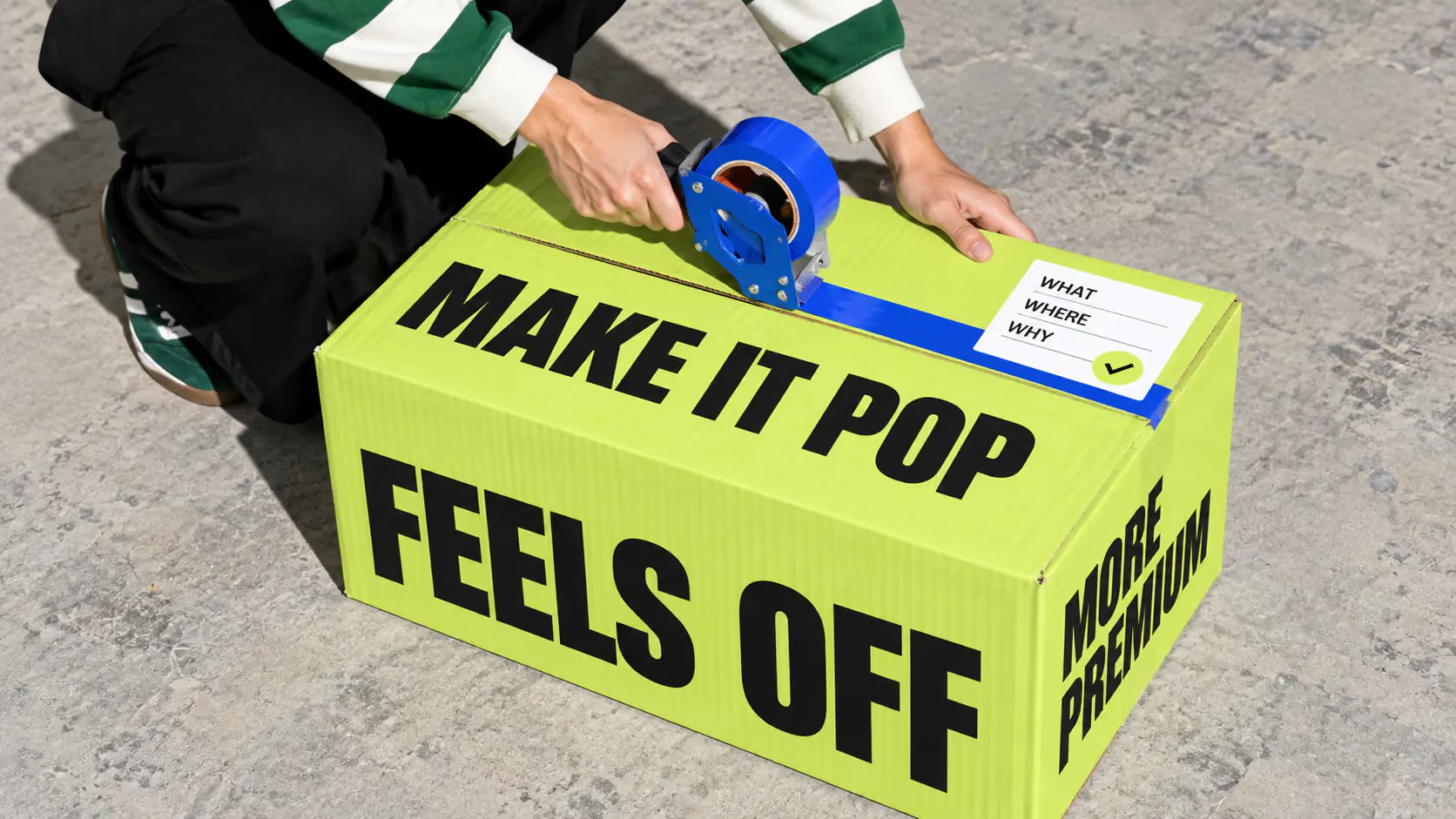
"Can we make this pop more?" requires a conversation before anyone can do anything with it. "The contrast on the headline feels low against the background image" does not.
Honestly? Both are common.
But the first type creates a clarification loop: the PM messages the client, the client responds two days later, the designer finally gets a clear direction and starts the revision. Multiply that loop across ten pieces of vague feedback on a single project and you've added days to the timeline without anyone making a single bad decision.
Contextual annotation, where a reviewer pins a comment directly to the element they're talking about, cuts that loop dramatically. The feedback arrives with its own context built in, and the designer can just start.
4. By the time anyone knows there's a problem, it's already expensive
A Creative Director who needs to know if a project is at risk has to ask. A PM who wants to know if a designer is blocked has to ask. An account manager who needs to know whether to tell the client things are on track has to ask.
Everyone is asking someone, constantly, and that asking is its own kind of overhead that nobody ever accounts for in a project plan.
The asking takes time. The answering takes time. And the problem being asked about has often been developing for longer than anyone realised, because no one knew to look until someone thought to ask.
Progress is estimated, not measured.
"We're about 60% of the way through" is a human reading of an unclear situation, and it tends toward optimism. The person saying it is probably thinking about effort spent rather than work remaining, and those two things rarely correlate cleanly.
Projects that feel 60% done on Wednesday sometimes reveal themselves as 40% done when you count the actual tasks left.
Building deadline plans on gut feel means building them on a number that's almost always slightly wrong, in a direction that compounds quietly until it doesn't.
The alternative is progress derived from the real state of the work: tasks completed, files approved, reviews closed, rather than anyone's read of the situation.
The people with authority to fix a problem are usually the last to know about it.
When the only way to know a project is in trouble is for someone to say it's in trouble, a lot has to go right. The person closest to the problem has to recognise it as a risk worth escalating, decide it's worth bringing up, and have a clear channel to do so, all while managing the day-to-day of the project itself.
That's a lot to ask of someone who is already stretched.
So problems that were recoverable on Monday get flagged on Thursday, by which point the Creative Director or agency owner is hearing about a crisis rather than a risk - at precisely the moment it's hardest to do anything about it.
A role-aware dashboard changes that: one where a Creative Director sees project health at a glance, a PM sees task progress, and at-risk projects surface automatically based on the actual state of the work rather than waiting on someone to report it.
That's what we built QuickProof for
The pattern across all four of these problems is the same: work that should be automatic is being done manually, by people, using tools that were never designed for it.
These kinds of problems disappear when the system is built around how creative work actually moves.
QuickProof connects the entire creative workflow - brief, tasks, files, review, approval, delivery - in one place, so the coordination overhead that's quietly eating your team's time has nowhere left to hide.
The brief lives inside the project, pinned and version-controlled, so scope questions have a single answer and changes require an explicit decision. Assets are organised in a central media library with clear version history and status, so nobody is ever working from the wrong file. Feedback lands in a structured review environment and converts directly into trackable tasks, so comments don't disappear into threads. Approval is a recorded event tied to a specific file version, so "I thought this was signed off" stops being a conversation.
And for the people who need to see how things are going without asking: role-aware dashboards that surface project health automatically, based on the actual state of the work.
It won't fix every deadline.
But it will stop the system from being the reason they slip.